For a long time, the idea of significant outside investment in the Irish League would have felt unusual.
Football clubs across Northern Ireland have traditionally been built around local communities, volunteers and generations of supporters. Ambition has always existed, but financial resources have often been limited.
In recent years, that has changed.
Larne’s remarkable rise has shown what sustained investment can achieve. Glentoran have spent years rebuilding under Ali Pour, Coleraine have embraced a full-time future following a change in ownership, and now Cliftonville have become the latest major Irish League club to welcome significant external investment.
Meanwhile, Carrick Rangers demonstrate that investment does not necessarily have to mean simply throwing money at players.
So, is this the beginning of a new era for Irish League football?
LARNE SHOWED WHAT WAS POSSIBLE
No club better represents the impact investment can have than Larne.
When Kenny Bruce began investing in his hometown club in 2017, Larne were playing Championship football. The transformation since has been extraordinary: promotion, major trophies, back-to-back Premiership titles and a place in the UEFA Conference League’s league phase.
The investment wasn’t limited to the playing squad. Facilities, infrastructure and the club’s overall professional operation were transformed alongside the team.
Larne have also shown that investment can evolve. In 2025, Redball Global FC acquired a 50% shareholding, bringing additional experience in international football and sports business into the club’s ownership structure.
Larne’s story has undoubtedly raised expectations across the league. It proved that an Irish League club could think bigger – and, crucially, compete beyond Northern Ireland.
GLENTORAN’S LONG-TERM PROJECT
Glentoran’s investment has followed a different path.
Ali Pour’s consortium completed its takeover in 2019 with ambitions to restore one of Northern Ireland’s biggest clubs to the top of the game. The journey has not always been straightforward, and the level of success on the pitch has arguably not yet matched the scale of the ambition.
But investment has provided the Glens with something important: the ability to plan for the long term.
Pour increased his shareholding to approximately 95% in 2025, with the club highlighting ambitions to invest further in infrastructure, facilities, squad development and revenue generation while retaining a supporter stake in the club.
The proposed redevelopment of the Oval is another example of how investment can look beyond the next transfer window. Plans for a major redevelopment have received planning permission, potentially transforming one of the Irish League’s most historic grounds.
Success cannot simply be bought, and Glentoran’s recent history proves that. But investment has given the club the platform to keep building.
COLERAINE ARE THINKING BIG
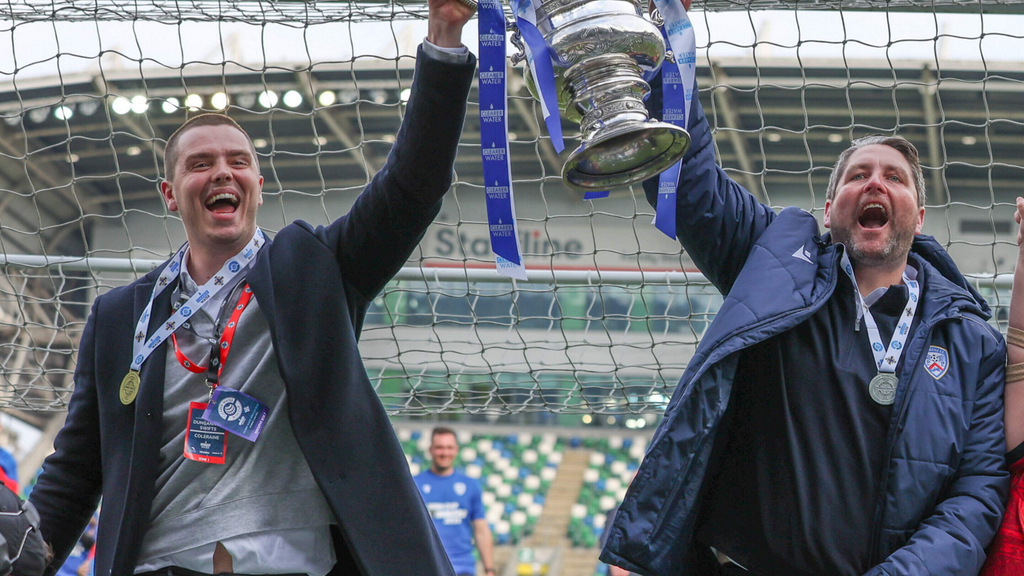
Coleraine’s transformation has been one of the most significant recent developments in the Irish League.
The club was taken over by Bannsiders Holdings in 2024, led by Ranald McGregor-Smith and Patrick Mitchell, before local property developer Henry Ross increased his investment to become majority owner later that year.
The most obvious consequence has been Coleraine’s move towards a full-time model. That brings a different level of expectation and financial commitment, but it also gives the club an opportunity to compete at a level that would previously have been difficult to sustain.
And the ambition is clear. Coleraine’s ownership has spoken openly about wanting the club to become one of the leading forces in the Irish League.
The results on the pitch this season suggest they are not waiting around.
CLIFTONVILLE ARE THE LATEST TO JOIN THE TREND
And now Cliftonville are the latest club preparing for a new chapter.
The Reds’ membership recently backed a multi-million-pound investment proposal from the Toronto Investment Group, with reports suggesting a cash injection of more than £3 million over three years. The scale of the investment represents a significant moment for a club with a proud history and a unique membership structure.
For Cliftonville, the challenge will be balancing ambition with identity.
The club’s history, community and supporter involvement are a huge part of what makes it special. Outside investment should not mean abandoning those things – ideally, it should provide the resources to protect and strengthen them.
But the fact Cliftonville have become the latest club to attract major investment says something important: the Irish League is increasingly being seen as a place worth investing in.
INVESTMENT DOESN’T ALWAYS MEAN A QUICK FIX
Carrick Rangers offer a slightly different example.
American businessman Michael Smith became the club’s majority owner with a vision based around sustainable growth, commercial development and using his experience and connections to create new opportunities. Smith himself stressed that the aim was not to spend recklessly in pursuit of short-term success.
That approach is particularly interesting.
Investment does not always have to mean a bigger wage bill or expensive signings. It can mean better marketing, stronger commercial partnerships, improved facilities and new ways of bringing money into a football club.
Carrick’s strategic partnership with US-based Fan Owned Club is another example of a club looking beyond Northern Ireland for commercial opportunities.
For clubs outside the traditional Irish League giants, that kind of thinking could be just as valuable as a major cash injection.
BUT WHAT ABOUT THE REST OF THE LEAGUE?
Of course, investment brings an obvious question: what happens to the clubs that don’t have it?
If some clubs can afford to go full-time, improve their facilities and attract better players while others are operating on much smaller budgets, the financial gap could grow.
That is a genuine concern. A stronger Irish League should not simply mean a small group of wealthy clubs becoming impossible to compete with.
But there is another way to look at it.
If investment raises the overall standard of the league, improves stadiums, attracts attention and helps Irish League clubs perform better in Europe, there can be benefits beyond the clubs receiving the initial investment.
More successful clubs can help create a more valuable league. Better facilities can improve the matchday experience. Greater interest can attract sponsors and supporters. European progress can raise the profile of Northern Ireland football as a whole.
The challenge for the league and its clubs is ensuring that growth is shared wherever possible.
WHY ARE PEOPLE INVESTING NOW?
Perhaps the most interesting question is why this is happening now.
The Irish League has always had passionate supporters and historic clubs, but it is becoming a more attractive product. Attendances are growing, clubs are improving their media output and facilities, and European football has demonstrated that Northern Irish sides can compete on a bigger stage.
Investors are not arriving because the Irish League is already a finished product. They are arriving because they see potential.
Michael Smith described the league as an “under-valued product” with significant room for growth – and whether you agree with that assessment or not, the increasing interest from investors suggests others are starting to see the same opportunity.
That might be the biggest change of all.
A NEW ERA – IF IT IS DONE RIGHT
Outside investment is not a guarantee of success.
Football is full of examples of owners making big promises before disappearing, leaving clubs in a worse position than before. Every Irish League club must protect its long-term future and make sure investment is responsible, sustainable and in the best interests of the club and its supporters.
But there is plenty to be optimistic about.
Larne have already demonstrated what sustained ambition can achieve. Glentoran and Coleraine are building towards major futures, Carrick are exploring new commercial opportunities, and Cliftonville’s latest development suggests that the trend is continuing.
The Irish League is changing.
The important thing now is that investment is not viewed simply as a race to spend the most money. If used properly, it can improve facilities, create stronger clubs, raise standards and help the league become a more attractive product both at home and abroad.
For years, Irish League clubs have been told to know their place.
Increasingly, it seems that some of them are deciding to find out just how far they can go.
And that could be very good news for the league as a whole.